Unlocking History: The Art of 16 Vintage Tibet Postcards Backgrounds
A Journey Through Time for Your Creative Projects
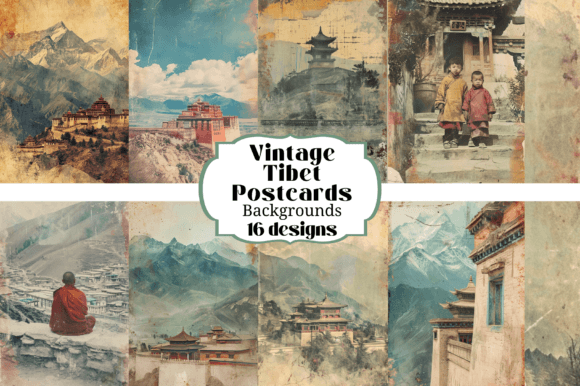
There’s a unique texture to history that’s hard to replicate digitally. It’s the feel of aged paper, the muted tones of a faded photograph, and the subtle imperfections that tell a story. For designers and creators, capturing that authentic vintage essence is a constant pursuit. The 16 Vintage Tibet Postcards Backgrounds collection offers a direct portal to that bygone era, providing a rich foundation for projects that demand depth, character, and a sense of place. This isn't just a set of digital paper backgrounds; it's a curated gallery of historical illustrations, each with its own visual personality.
Imagine the weathered textures, the subtle sepia and ochre tones, and the intricate line work characteristic of early 20th-century postcards. These backgrounds embody a specific aesthetic—part colonial exploration, part cultural documentation. The visual style is inherently premium, with a nuanced complexity that generic filters can't achieve. The personality is one of quiet mystery and established elegance, making it a powerful design asset for projects that need to stand out with substance rather than loud graphics. It’s a creative resource that speaks to a refined taste, appealing to audiences who appreciate craftsmanship and narrative depth in visual design.
Strategic Applications for the Modern Creative
Understanding where these vintage Tibet postcards digital paper backgrounds excel is key to leveraging their full potential. Their strength lies in adding immediate context and a sophisticated layer of visual interest. For editorial design, they serve as compelling backgrounds for feature articles about history, travel, or culture. A publisher could use them to create stunning chapter openers or decorative borders in a book on Asian art. In packaging design, particularly for artisanal goods, teas, or heritage brands, these textures can instantly communicate authenticity and a story worth telling.
Digital applications are equally powerful. Web designers can use them as subtle background textures for hero sections or blog posts, adding warmth and depth without overwhelming content. For social media graphics, they provide a perfect canvas for quotes, announcements, or promotional material that needs a touch of timeless class. Think of a marketer for a museum gift shop or a specialty bookstore using these as the foundation for their entire campaign—the consistent use of such a distinctive typeface of imagery (if you will) builds a recognizable brand identity. They are also ideal for personal projects like scrapbooking, junk journals, and card making, where the goal is to create tangible, heirloom-quality pieces.
Integrating Vintage Textures with Modern Typography
The true craft emerges when pairing these detailed backgrounds with modern typography. The key is to create contrast and hierarchy. Because the backgrounds are visually rich, the foreground text must be exceptionally clear. This is where a clean sans serif font often works best. A bold, geometric sans serif for headlines can cut through the visual noise, while a highly legible serif font or a simple script font for body text can maintain readability against the textured surface. Avoid overly ornate or handwritten fonts for large blocks of text, as they may become difficult to read.
Consider the emotional resonance. Pairing the backgrounds with a modern, minimalist display font creates a striking juxtaposition—old world meets new. This can be particularly effective for a brand identity that wants to appear both established and contemporary. For a more cohesive, thematic approach, a typeface with slightly rounded, organic forms might echo the hand-drawn quality of the original postcard illustrations. Always test your font pairing at the final size and on the actual background. Check the contrast, the letter spacing, and the overall visual hierarchy. The goal is to let the vintage texture enhance your message, not compete with it. This thoughtful integration is what elevates a project from good to genuinely professional.
A Practical Guide to Using This Digital Download
This collection is delivered as a digital download, meaning you get instant access to high-resolution PNG files. The files are at 300 DPI, making them suitable for high-quality print projects where detail matters. Each image is separate and clearly named for easy organization. A critical advantage is that these files are free of watermarks, giving you complete creative freedom.
When evaluating fit for your project, start by examining the mood of each of the 16 designs. Some may feature more architectural elements, others might highlight landscape or cultural motifs. Choose the background that best complements your subject matter. For commercial use, such as in products for sale or client work, the licensing for this digital paper set typically allows for broad application, but it’s always prudent to double-check the specific terms provided with your purchase. To begin, simply unzip the downloaded file and import the PNGs into your preferred design software—whether that’s Adobe Photoshop, Illustrator, Canva, or a journaling app. Resize them as needed; the high resolution ensures they remain sharp. These are versatile craft and design assets built to be used, not just admired. By applying them thoughtfully, you embed a piece of history into your work, creating something that feels both authentic and intentionally designed.